
Mia McKenna-Bruce stars in a sharp, modern update of Agatha Christie’s classic mystery.
Agatha Christie Binge
How do you solve a problem like a ninety-five-year-old mystery? For Netflix and screenwriter Chris Chibnall, the answer isn’t to rewrite the soul of the story, but to polish the silver until it reflects the present.
Agatha Christie’s Seven Dials is a rare feat in the modern “Whodunnit” landscape: a three-episode binge that manages to be both a period-perfect time capsule and a sharp, sensitive update of a writer who didn’t always get her secondary characters right.
The “It Girl” and the Eight Clocks
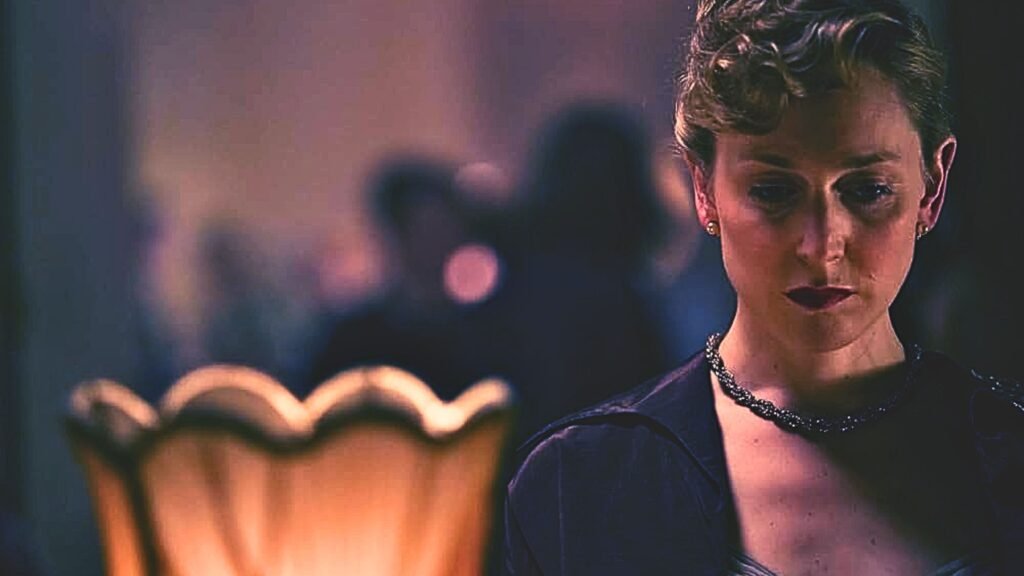
At the center of the storm is Eileen “Bundle” Brent, played with a relentless, understated spark by Mia McKenna-Bruce.
Bundle is the aristocrat the world forgot—an amateur detective Christie introduced in 1929 and then effectively abandoned in favor of Poirot and Marple.
The premise remains one of Christie’s most haunting: a house party prank involving eight alarm clocks ends with a dead friend, seven clocks neatly arranged on a mantelpiece, and a mystery that stretches from a country manor to a shadow organization.
A Corrective Lens on History
While the series maintains the 1925 setting, it quietly performs a “sensitivity audit” on Christie’s world.
The most significant shift is the inclusion of a scientist from Cameroon, played by Nyasha Hatendi. In Christie’s original era, “foreigners” were often caricatures or plot devices.
Here, Hatendi provides a thoughtful, intellectual weight that balances the eccentricities of Helena Bonham-Carter’s Lady Caterham.
It is a modernization that doesn’t feel like a lecture; it feels like a correction.
The Momentum of the Locomotive
Unlike the recent cinematic outings of Hercule Poirot, which often feel weighed down by their own theatricality, Seven Dials moves with “boundless energy.”
A pivotal reveal that took place in a static chamber in the novel is relocated to a speeding train.
This shift isn’t just aesthetic; it injects a sense of cinematic urgency that Christie’s 1920s prose sometimes lacked.
By moving the mystery onto the rails, the show transforms a head-scratching puzzle into a high-stakes mission.
The Freeman Effect
The casting of Martin Freeman as Inspector Battle is a stroke of counter-intuitive genius. Typically, we expect the detective to be the catalyst for the solution.
In Seven Dials, Battle acts as a bureaucratic anchor, frequently hindering Bundle’s frantic movements.
The show succeeds because it understands that Bundle is the protagonist and Battle is the obstacle—a reversal of the typical “Great Man” detective trope.
the “Minor” Masterpiece
The Seven Dials Mystery is rarely cited as Christie’s best work, which is exactly why the Netflix series works so well.
Free from the baggage of a “classic,” the creators have room to breathe.
They’ve enhanced the plotting, leaned into McKenna-Bruce’s feisty performance, and delivered a production that is as handsome as it is smart.
Key Takeaways:
- Bundle Brent is back: Mia McKenna-Bruce proves that Christie has more than just two iconic detectives.
- Respect the plot, update the person: The series proves you can fix historical stereotypes without changing the “Whodunnit” mechanics.
- Short and Sweet: The three-episode format (roughly three hours) is the perfect “mileage” for a Christie mystery.

Breaking celebrity news and hot gossip. We deliver the juiciest stories and trending star updates fast.