
Leaked court texts reveal Taylor Swift’s role in the Blake Lively and Justin Baldoni feud.
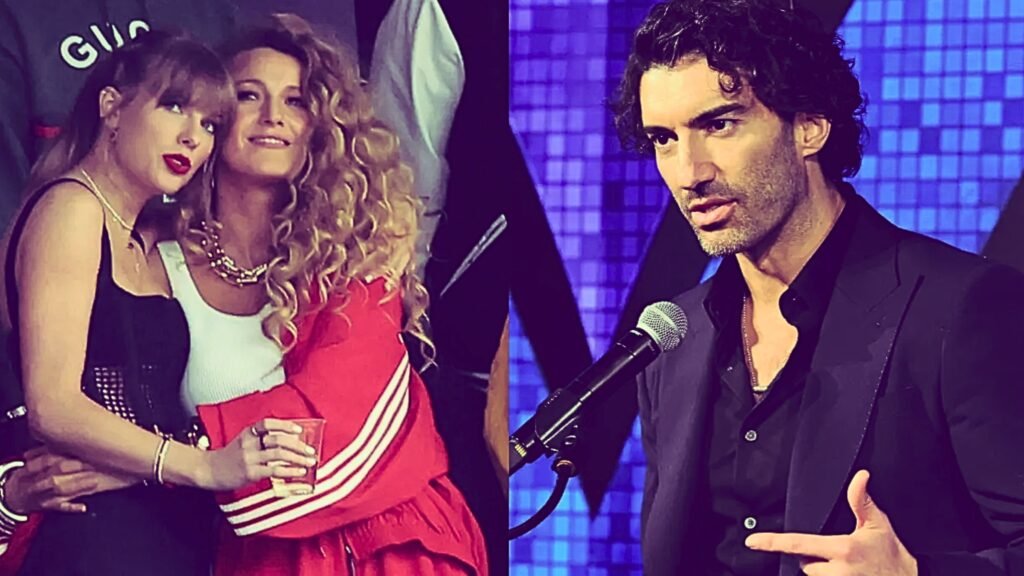
Table of Contents
Can a pop star who never stepped foot on a movie set fundamentally alter the power dynamic of a multi-million-dollar production? As the legal fallout from It Ends With Us spills into the public record, the answer appears to be a definitive “yes.”
Court documents have unveiled a private digital war room where Taylor Swift and Blake Lively allegedly strategized to sideline director Justin Baldoni, using everything from “tiny violins” to strategic song placements.
The “Doofus” and the “Dragon”
The leaked text messages, submitted as part of the ongoing litigation between Lively and Baldoni, paint a picture of a production fractured by a powerful inner circle.
Blake Lively reportedly referred to Baldoni as the “doofus director,” while Taylor Swift was even less diplomatic, allegedly labeling him a “b**ch” in private exchanges.
Baldoni’s countersuit claims he felt immense pressure from Lively’s “dragons”—a term Lively used to describe her protective circle, including her husband Ryan Reynolds and Swift.
This wasn’t just a clash of personalities; it was a battle for the “soul” of the film’s final cut.
Strategic Musical Warfare
Perhaps the most revealing aspect of the documents is the discussion surrounding Swift’s song, My Tears Ricochet. Far from a simple licensing agreement, the song was discussed as a tactical asset.
- The Power Play: Swift texted Lively in April 2024, suggesting that if Baldoni were “strategic,” he would avoid using her music in the trailer because having Swift’s endorsement gave Lively “more power over the film.”
- The Script Endorsement: Documents suggest Lively asked Swift to endorse a revised version of the script without Swift having read a single page. Swift’s response—”I’ll do anything for you!!”—highlights a loyalty that transcends professional due diligence.
The “Tiny Violin” Prophecy
In December 2024, ahead of a New York Times article detailing Baldoni’s alleged “smear campaign” against Lively, Swift’s texts took a prophetic turn.
“I think this b**ch knows something is coming because he’s gotten out his tiny violin,” she wrote.
This exchange suggests that the “Lively camp” was well aware of the impending media storm and viewed Baldoni’s defensive maneuvers as performative victimhood.
However, the narrative is complicated by Lively’s subsequent denial that she ever discussed the NYT article with Swift or asked for blind script endorsements.
The Fallacy of the “Uninvolved” Superstar
Most industry analysts looked at Swift’s “distancing” statement in June 2025 as a sign that she was a peripheral figure. This is a fundamental misunderstanding of modern celebrity influence.
- Allies as Assets: Swift’s advice to Lively regarding the trailer proves that she understands industry leverage better than most executives. By framing her music as an “ally” for Lively and a threat to Baldoni, she turned a soundtrack choice into a coup.
- The “Dragons” Effect: Even if Swift had no formal role, her presence in the text chain acted as a psychological weight. For a director like Baldoni, arguing with a producer is one thing; arguing with a producer who has the unconditional, “anything for you” support of the world’s biggest music star is an entirely different level of conflict.
The Verdict
While Taylor Swift’s representative has worked to clarify that the star has no formal involvement in the film’s legal woes, the court documents tell a more complex story of “influence by association.”
It Ends With Us may have been based on a book about domestic trauma, but its behind-the-scenes legacy is becoming a case study in how private friendships can become public power struggles.

Breaking celebrity news and hot gossip. We deliver the juiciest stories and trending star updates fast.
Pingback: ryan Reynolds described in an email as a "pantheon"